
The Market Has Moved. And Buyers Are Already Paying a 25% Premium for It.
For years, healthy buildings were viewed as a competitive advantage. Today, they're becoming a market expectation.
What's changed isn't the science. It's the market. And the numbers make that hard to ignore.
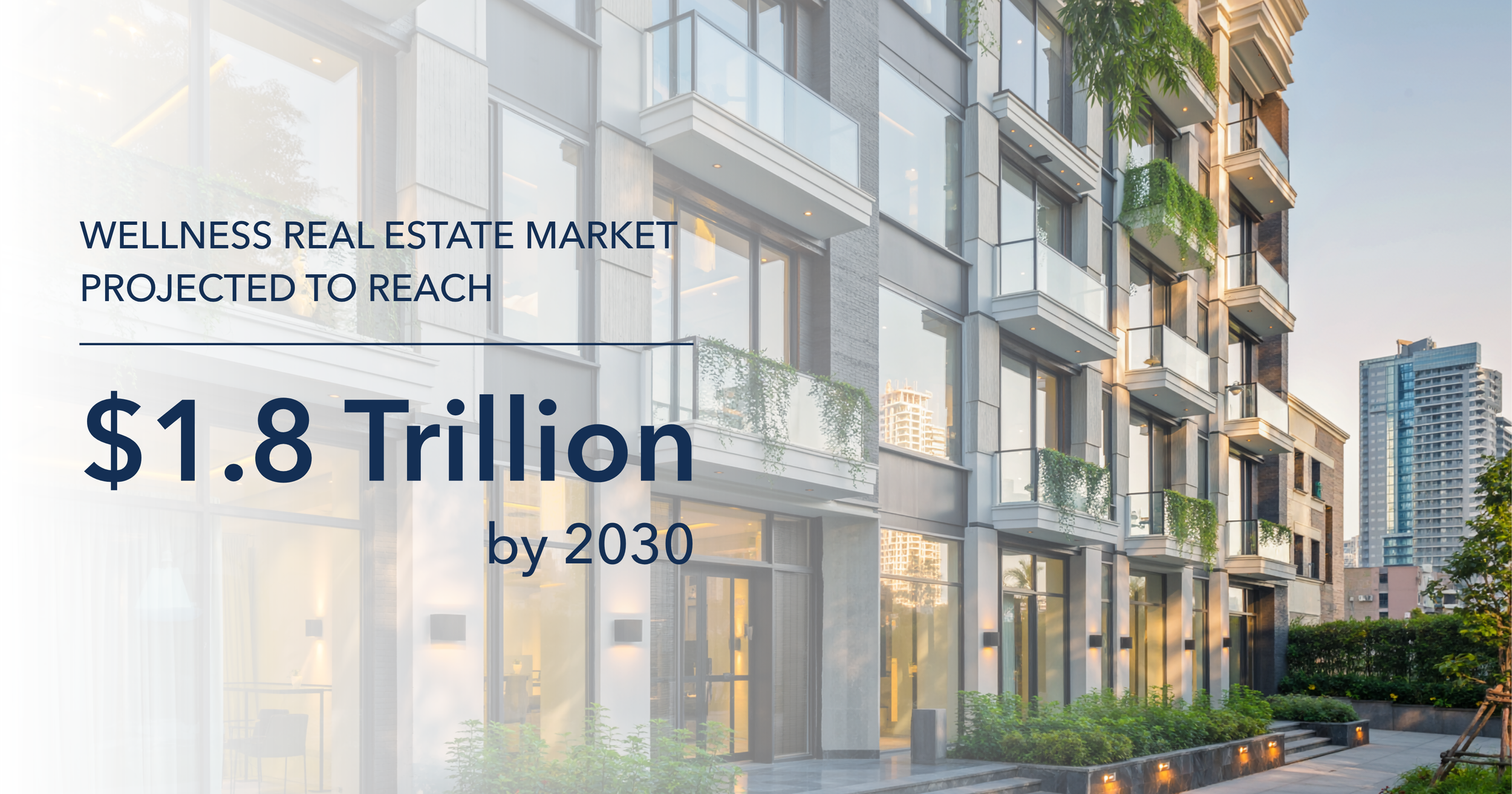
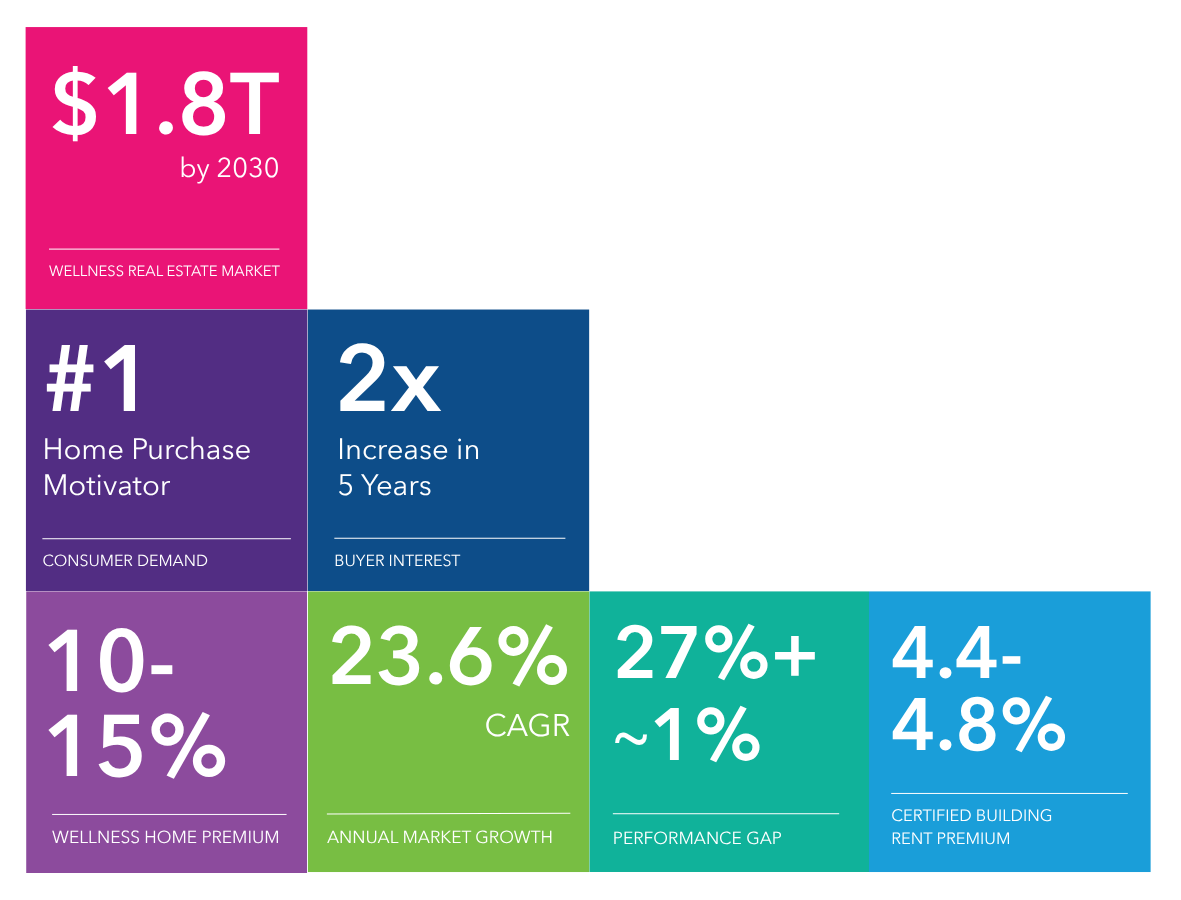
Sotheby's International Realty's 2026 Mid-Year Luxury Outlook reports that wellness-positioned homes now command premiums of 10 to 25% over comparable conventional properties, and buyer interest in wellness real estate has more than doubled over the past five years. Sotheby's projects the global longevity market alone will reach 8 trillion by 2030, with wellness real estate climbing to $1.8 trillion in that same window.
Consumers, investors, lenders, and developers are increasingly recognizing that healthier buildings deliver measurable value. Together, the data points to a clear conclusion: health is becoming one of real estate's strongest performance indicators.
Consumer demand is reshaping the market.
The Global Wellness Institute estimates the wellness real estate market grew from $151 billion in 2017 to $876 billion in 2025 and is projected to reach $1.8 trillion by 2030, representing a 23.6% compound annual growth rate.
This mirrors what's happening in the residential sector, where Sotheby's has tracked the same wellness premium taking hold across the luxury market.
People aren't simply buying square footage anymore. They're investing in environments that support healthier, longer, and better lives.
Health is creating measurable financial value.
The business case has evolved alongside consumer demand.
Independent research from Cambridge University (2025), reinforcing earlier findings from MIT, found that health-certified buildings achieve a 4.4 to 4.8% rent premium, independent of any brand or wellness premium already associated with a property.
In the residential sector, Sotheby's International Realty's 2026 Mid-Year Luxury Outlook reports that wellness-positioned homes command premiums of 10 to 25% compared with comparable conventional properties.
These aren't simply indicators of market preference. They demonstrate that health is a defining driver in influencing pricing, leasing performance, and asset value.
Institutional capital is paying attention.
Perhaps the strongest signal is coming from the investment community.
Major institutional investment owners are increasingly incorporating health certification into their investment and lending strategies. Harrison Street, one of the largest owners of student and senior housing in the US, now incorporates Fitwel certification into its investment criteria across hundreds of assets.
Certification becoming part of investment due diligence, reflecting growing recognition that healthier buildings contribute to stronger operational performance, resilience, and long-term returns.
The cost of waiting is becoming clearer.
The market is also revealing the downside of inaction.
Commercial real estate data from JLL and CBRE shows widening performance gaps between higher-quality certified buildings and lower-quality, non-certified assets. In some markets, lower-quality office stock is experiencing vacancy rates exceeding 27%, while top-tier certified buildings remain near 1% vacancy.
While each asset class has unique dynamics, the broader trend is difficult to ignore. As tenants, investors, insurers, and lenders become more sophisticated, health certification is now viewed as a trusted signal of building quality and long-term performance.
Industry leaders are already moving.
Leading organizations aren't waiting for the market to mature.
Marriott International recently (June 2026) partnered with Fitwel to advance evidence-based health strategies across its global branded residential portfolio. Aldar has demonstrated what's possible by embedding health into community-scale development, including the world's first Fitwel-certified island, Fahid Island. These organizations recognize that health isn't simply about occupant well-being. It's an increasingly important driver of long-term value, resilience, and market differentiation.
The market has moved.
Taken individually, each of these data points is noteworthy. Together they tell a much bigger story. Consumer demand is accelerating, institutional capital is evolving, and measurable financial outcomes continue to reinforce the value of healthier buildings. Health is no longer viewed solely as a sustainable initiative or a premium amenity. It is becoming a defining characteristic of high-performing real estate.
For owners, developers, and investors, the conversation is no longer about whether health belongs in the built environment. The market has already answered that question. The opportunity now is to determine how your portfolio will respond to changing expectations and position itself for long-term success in an increasingly health-conscious market.

Joanna Frank
President and CEO | Center for Active Design
President and CEO | Active Design Advisors, Inc. (Adai)
Search Blog Articles
By Category
- Adai News
- Best in Building Health
- Certification
- Conferences
- ESG
- Featured
- Fitwel Ambassadors
- Fitwel Champions
- Fitwel Platform
- Fitwel Providers & Partners
- From the CEO
- Healthy Building Profiles
- Podcasts
- Press & Media
- Publications & Reports
- Research Insights
- Strategies & Solutions
- Viral Response Module
- Webinars
By Month
- August 2026
- April 2026
- March 2026
- February 2026
- December 2025
- November 2025
- October 2025
- September 2025
- July 2025
- May 2025
- April 2025
- March 2025
- February 2025
- January 2025
- December 2024
- November 2024
- October 2024
- September 2024
- August 2024
- July 2024
- June 2024
- May 2024
- April 2024
- March 2024
- February 2024
- January 2024
- December 2023
- November 2023
- October 2023
- September 2023
- August 2023
- July 2023
- June 2023
- May 2023
- April 2023
- March 2023
- February 2023
- January 2023
- December 2022
- November 2022
- October 2022
- September 2022
- June 2022
- May 2022
- April 2022
- March 2022
- February 2022
- January 2022
- December 2021
- May 2021
- April 2021
- March 2021
- October 2020
- July 2020
- May 2020