
Why Health. Why Certification. Why Fitwel®.
Did you know? Up to 40% of your health outcomes are shaped by your environment.
Fitwel-certified properties are designed to make you healthier every day.
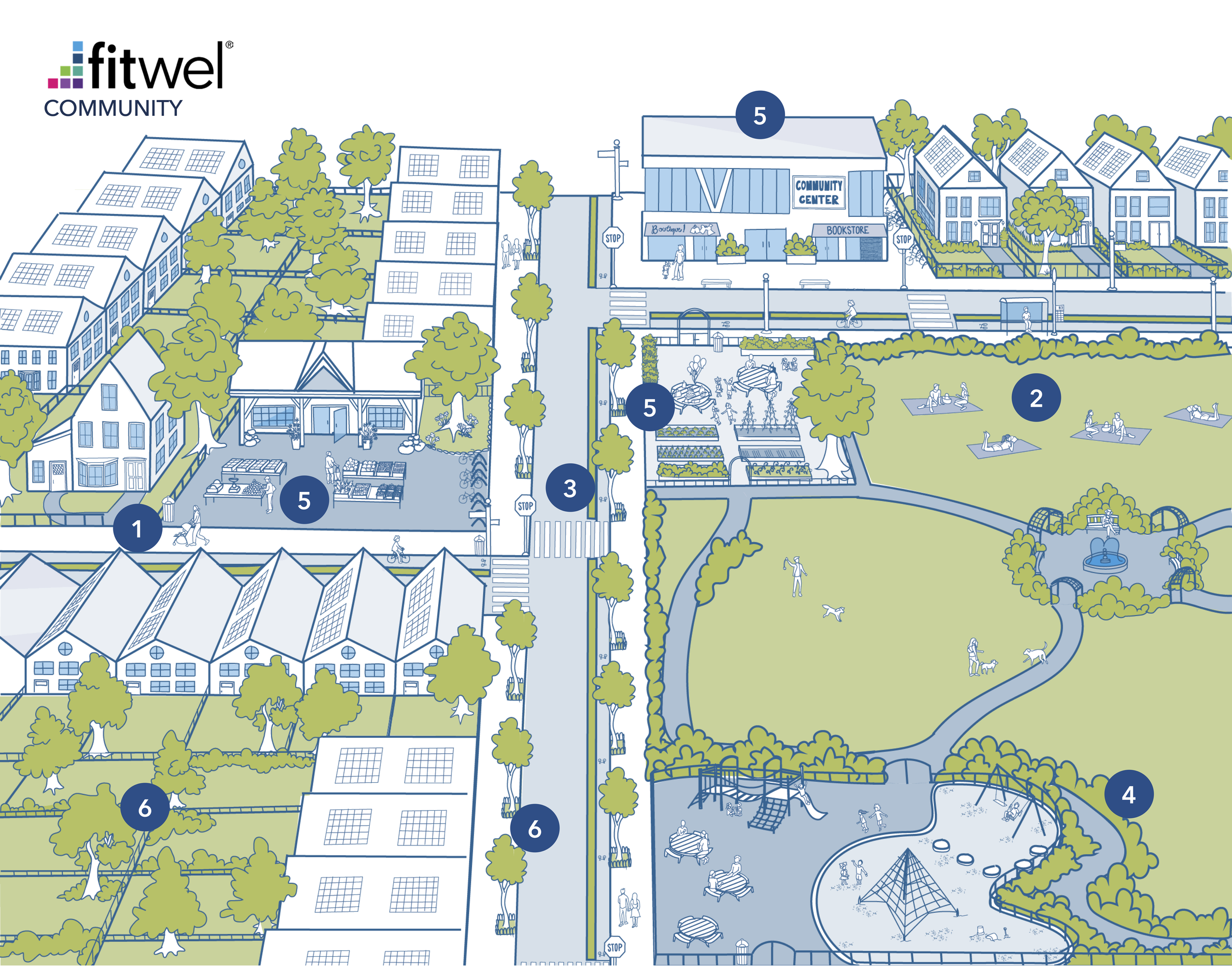
1. Walk more. Feel better.
Living in a walkable community makes everyday movement easy. Nearly 60% of people say they’d pay more to live in a walkable neighborhood, reflecting the value residents place on convenience, health, and connection. 1
2. Parks bring people together.
Thoughtfully designed parks and playgrounds encourage physical activity for all ages while creating spaces where neighbors can connect, play, and spend time together—supporting both physical health and social connection. 2
3. Bike-friendly by design.
Protected bike lanes offer safe, affordable ways to get around while supporting regular physical activity—making healthy movement part of daily life, not an extra task. 3
4. Paths to move and unwind.
Walking paths, especially those set in natural surroundings, support both physical activity and mental restoration. Time spent walking outdoors has been shown to reduce stress and improve overall well-being. 4
5. Spaces that build community.
Community centers, gardens, libraries, and shared gathering spaces help reduce social isolation and strengthen connections, building a stronger sense of belonging among residents. 5
6. More trees. More Restoration.
Tree canopy provides shade, cooling, and access to nature—helping residents feel more relaxed, stay cool, and even reduce household energy costs. 6
Life Thrives Here.
Fitwel-certified properties are optimized to promote your health, safety, and quality of life.
National Community and Transportation Preferences Survey. (2023). https://www.nar.realtor/sites/default/files/documents/2023-community-and-transportation-preferences-survey-slides-06-20-2023.pdf
Gemmell, E., Ramsden, R., Brussoni, M., & Brauer, M. (2022). Influence of neighborhood built environments on the outdoor free play of young children: A systematic, mixed-studies review and thematic synthesis. Journal of Urban Health, 100(1), 118–150. https://doi.org/10.1007/s11524-022-00696-6
Pan, X., Zhao, L., Luo, J., Li, Y., Zhang, L., Wu, T., Smith, M., Dai, S., & Jia, P. (2020, April 1). Access to bike lanes and childhood obesity: A systematic review and meta‐analysis - pan - 2021 - obesity reviews - wiley online library. WILEY. https://onlinelibrary.wiley.com/doi/abs/10.1111/obr.13042
Heidarzadeh, E., Rezaei, M., Haghi, M. R., Shabanian, H., & Lee, Y. (2021). Assessing the impact of outdoor activities on Mental Wellbe-ing; focusing on the walking path in Urban Area. Iranian Journal of Public Health. https://doi.org/10.18502/ijph.v50i10.7517
Johnson, C. A. (2012). How do public libraries create social capital? an analysis of interactions between library staff and patrons. Library & Information Science Research, 34(1), 52–62. https://doi.org/10.1016/j.lisr.2011.07.009
Iungman, T., Cirach, M., Marando, F., Pereira Barboza, E., Khomenko, S., Masselot, P., Quijal-Zamorano, M., Mueller, N., Gasparrini, A., Urquiza, J., Heris, M., Thondoo, M., & Nieuwenhuijsen, M. (2023). Cooling cities through urban green infrastructure: A health impact assessment of European cities. The Lancet, 401(10376), 577–589. https://doi.org/10.1016/s0140-6736(22)02585-5