
New Research in Real Estate: How Health Can Generate Financial Returns

Insights from the Center for Active Design Experts
Many in the real estate and sustainability industries have long recognized an intrinsic connection between healthy building interventions and financial performance, and new research now validates this relationship. This connection between health and value, which underpins Fitwel’s FSP product, builds on the well-established financial case for sustainability, from energy efficiency to waste and water management, by demonstrating that investments benefiting human health can deliver measurable financial returns. A new study tested this hypothesis and found that health-certified buildings and health-focused interventions unlock significant returns on investment for building owners.
On February 11, CfAD’s Sara Karerat joined Dr. Franz Fuerst, a Professor of Real Estate and Urban Economics at the University of Cambridge, to discuss this research and explore the financial benefits owners and operators can realize through healthy building interventions and certifications. You can listen to the full conversation here.
Why Health & Well-Being Matter for Real Estate
Dr. Fuerst opened the conversation by presenting the “3-30-300” rule of thumb. This concept proposes that the greatest return on investment in real estate comes from investing in occupants. The theory states that for every $3 spent on utilities, a typical company spends $30 on rent and $300 on employee salaries, making the human factor the most significant investment. With this in mind, ensuring that offices and commercial spaces are designed to optimize occupant performance and health becomes not simply a gesture of owner goodwill, but a strategic investment imperative. This is reinforced by rising consumer demand for health, with recent survey data indicating that 71% of residents value healthy building features in their apartment communities, and 75% of employees now expect their workplaces to support health and well-being.
Explore these tenant-focused resources to see how Fitwel Certification helps meet these expectations.
Translating Health Impacts to Financial Value
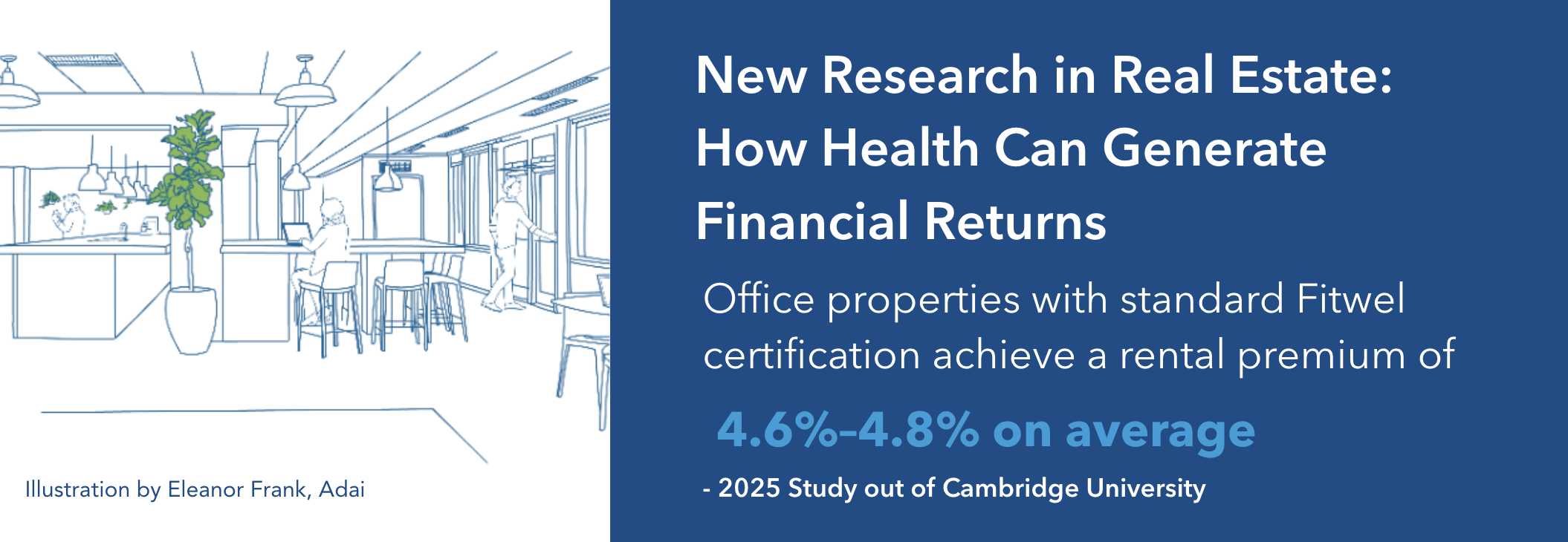
Last year, Dr. Fuerst and his team tested the hypothesis that healthy building investments are tied to financial performance. As described in the peer-reviewed article, Indoor and Outdoor Health Factors in the Pricing of Commercial Real Estate: A Hedonic Analysis of U.S. Office Buildings, they found that offices with a healthy building certification achieve 4-6% higher rents– demonstrating that investing in the “human factor” of real estate leads to measurable returns on investment. Dr. Fuerst and his research team also examined which individual interventions carried the greatest weight, finding that walkability had the strongest impact on rent, while proximity to health services and walkability were both strongly associated with resident willingness to pay. The study also explores the different impacts of Fitwel and WELL certifications on mean annual effective rent, finding that buildings with a WELL certification command an average of $52.53 per square foot, while Fitwel buildings achieve a higher rent of $55.26 per square foot, indicating a potential added value associated with Fitwel certification. This work highlights not only the value of the individual strategies within the Fitwel Standard and FSP product, but also the strong cumulative impact of the Fitwel Star Certification.
Dr. Fuerst also shared insights from his ongoing research, which builds on these findings, turning to the residential sector to explore how healthy building interventions impact long-term occupant health outcomes. While the findings are not yet published, early results of this multi-year, 30,000-person study indicate that higher housing prices are associated with better health outcomes, as reflected in biomarker data. He also highlighted the key takeaways of an ongoing study he is conducting using insights from UK Biobank data, which includes health data from approximately 500,000 middle-aged UK residents. In this study, his team found that housing not only creates lasting physiological changes across multiple systems, but also that material and economic stressors associated with housing quality and security interact, leading to health impacts that are greater than the sum of their parts.
The conversation closed with a lively discussion about the benefactors of these financial gains, considering both the owner and tenant perspectives, as well as “low-hanging fruit” strategies that capitalize on “win-win-win” scenarios – interventions that benefit owners, tenants, and the tenants' employees. As Dr. Fuerst noted, while it isn’t an exact science how these benefits are distributed amongst the stakeholder groups, investment in health can support tenant and employee satisfaction and retention, which can lead to longer-term gains in lease renewal rates and employee commitment.
Strategies focused on indoor environmental quality, from indoor air quality to thermal control and lighting quality, typically don’t require the significant upfront costs of a large retrofit and can capture synergies between health and financial returns for all three stakeholder groups. Many of these value points – where lower upfront costs interventions can yield substantial health and financial returns – are explored in another of Dr. Fuersts’ publications: Ten Questions Concerning the Economics of Indoor Environmental Quality in Buildings. Another key feature is that they can often be implemented regardless of a building’s age. In both of analyses, his team was able to confidently separate the impact of healthy building certifications and interventions from the modernity of the building–meaning these impacts are not exclusive to newer assets. These findings echo a core tenet of Fitwel certification, that any asset, regardless of age, size, or location, can implement healthy building interventions that positively impact occupant and tenant health and financial returns.
Health as a Central Business Priority
The findings discussed during the webinar validate the concept of the “triple dividend” or “triple bottom line” — that certain interventions can simultaneously benefit environmental, economic, and social outcomes. Validating the synergy among these impacts strengthens the case that health interventions need not be excess or add-on costs, but can be integrated into existing budgets and upgrades, ultimately generating financial returns. As Dr. Fuerst's research demonstrates, this relationship manifests not only in rising price per square footage, but across a broader spectrum of value drivers — including heightened tenant satisfaction and productivity, lower energy and maintenance costs, and expanded access to green financing and tax incentives. As building owners and management teams juggle diverse budget priorities, these findings and emerging research like it, can help to ensure that interventions with the greatest amount of diverse impacts, across social, financial, and environmental fields, are prioritized.
Search Blog Articles
By Category
- Adai News
- Best in Building Health
- Certification
- Conferences
- ESG
- Featured
- Fitwel Ambassadors
- Fitwel Champions
- Fitwel Platform
- Fitwel Providers & Partners
- From the CEO
- Healthy Building Profiles
- Podcasts
- Press & Media
- Publications & Reports
- Research Insights
- Strategies & Solutions
- Viral Response Module
- Webinars
By Month
- August 2026
- April 2026
- March 2026
- February 2026
- December 2025
- November 2025
- October 2025
- September 2025
- July 2025
- May 2025
- April 2025
- March 2025
- February 2025
- January 2025
- December 2024
- November 2024
- October 2024
- September 2024
- August 2024
- July 2024
- June 2024
- May 2024
- April 2024
- March 2024
- February 2024
- January 2024
- December 2023
- November 2023
- October 2023
- September 2023
- August 2023
- July 2023
- June 2023
- May 2023
- April 2023
- March 2023
- February 2023
- January 2023
- December 2022
- November 2022
- October 2022
- September 2022
- June 2022
- May 2022
- April 2022
- March 2022
- February 2022
- January 2022
- December 2021
- May 2021
- April 2021
- March 2021
- October 2020
- July 2020
- May 2020